

Short Answer
ClientView controls one stage: preparing and lodging your application to AusCheck. The background check is run by AusCheck, not by any issuer, so no provider can guarantee a total turnaround time. The fastest realistic result comes from a clean application lodged immediately.
That single fact is the most important thing to understand about MSIC timing, and it is the thing most advertised turnaround times quietly leave out. This guide explains why.
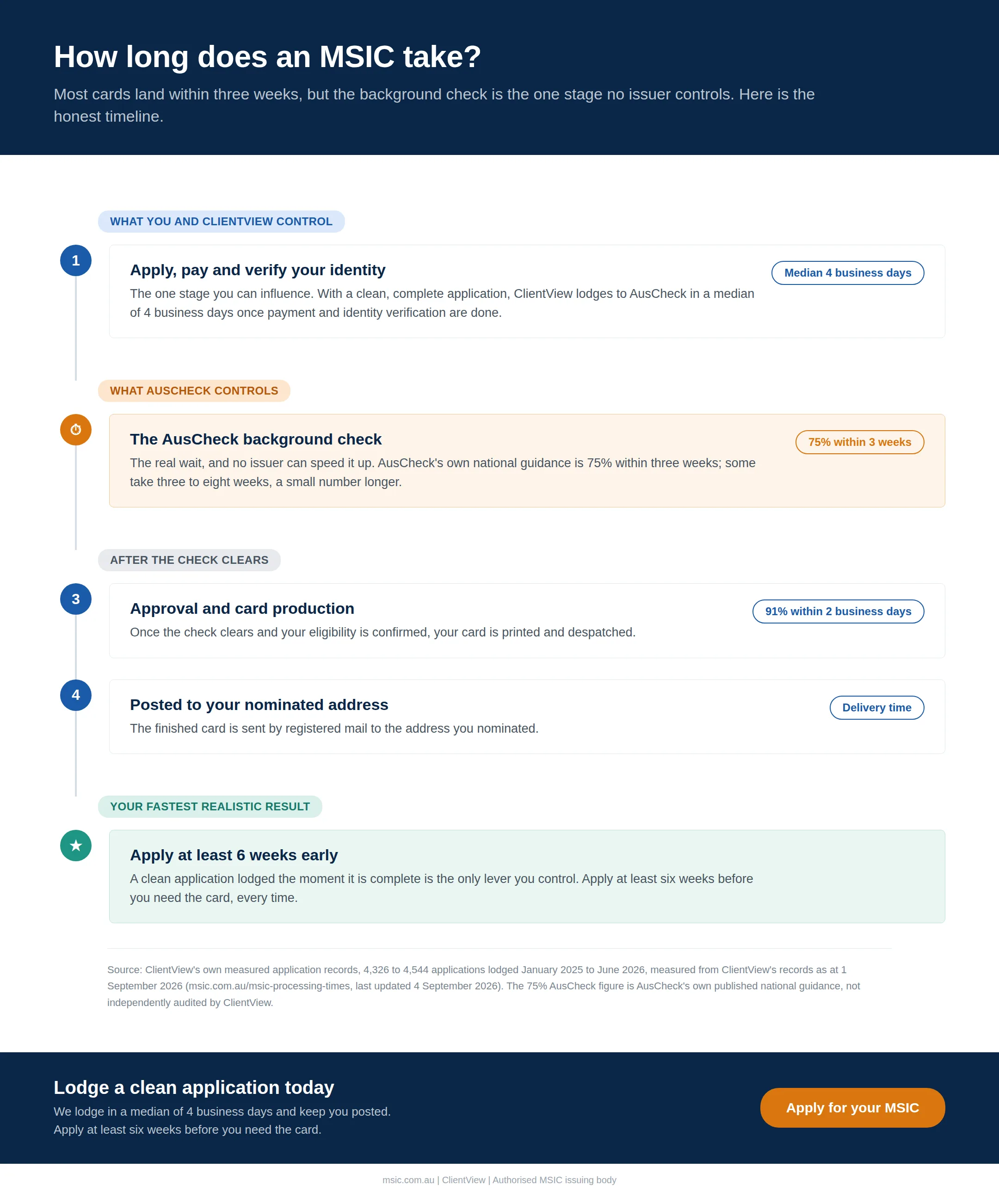
Quick facts about MSIC turnaround times
- 75% of applications are processed within 3 weeks of AusCheck receiving them.
- Some applications take 3 to 8 weeks due to factors like criminal history and security checks.
- A small number take over 8 weeks, and AusCheck asks those applicants to make contact.
- Official guidance: apply at least 6 weeks before you need the card finalised.
- No issuer controls the background check. It is coordinated by AusCheck, an Australian Government body.
- Fastest realistic results come from clean paperwork lodged immediately, not from any advertised promise.
Why can no MSIC provider guarantee a turnaround time?
Because the part that takes the longest is not theirs to control.
An MSIC is not a card you simply buy. It is the visible result of a multi-agency national security background check. Your issuer prepares and lodges your application, but the actual vetting is run by AusCheck and its partner agencies. Once your application reaches them, the timeline is in their hands, not the issuer's.
This is why a confident promise such as 'cards in two to three weeks' or 'four-day average approval' should be read carefully. At best it is an average of past results. At worst it measures only the one stage the provider does control, while staying silent on the stage that actually decides your timeline.
What are the four stages of getting an MSIC?
Every MSIC, whether new or a renewal, passes through four stages. Knowing them is the key to understanding why a single turnaround number is almost meaningless.
- Your application and identity verification. You complete the application, prove your identity, and have your photo taken. This stage is quick if your paperwork is in order and slow if it is not. It is the only stage where you and your issuer have real influence. If you are starting out, our step-by-step MSIC application guide walks through it in full.
- The AusCheck background check. Once your issuer approves the application and verifies your identity, it is submitted to AusCheck, which sends it to partner agencies for vetting. This is the stage no issuer can speed up, guarantee, or predict.
- Approval and card production. Once the check clears and your eligibility is confirmed, the card is produced.
- Dispatch and delivery. The physical card is posted to you, usually by registered mail.
When you see an advertised turnaround time, ask which stages it covers. A 'four-day approval' figure may measure only Stage 1, the provider's internal processing, while saying nothing about Stages 2 to 4, where most of the real waiting happens. 'Application lodged with the provider' and 'application received by AusCheck' are different milestones, and the gap between them is invisible in a headline number. If you have already applied, our guide to understanding your MSIC application status explains what each stage means.
What does the AusCheck background check involve?
The check is far broader than a simple police check, and it has no lookback period. The Regulations define an adverse criminal record by the offence and the sentence, not by how long ago the conviction was (r. 6.07B(3)), and Note 5 to r. 6.07B(1) records that convictions for certain offences do not become spent for the purpose of assessing whether to issue an MSIC. So an old conviction is not automatically behind you. Any declaration is made to AusCheck, not to ClientView, and if you are unsure whether something should be declared, declare it.
AusCheck coordinates four checks:
- A criminal history check through the Australian Criminal Intelligence Commission, covering all Australian jurisdictions
- An ASIO security assessment, which covers politically motivated violence
- A criminal intelligence assessment, given by the Chief Executive Officer of the Australian Crime Commission (r. 6.08C(1)(da))
- For non-citizens, a right to work check confirming visa status (r. 6.08C(1)(c)(ii))
The ten year figure that does apply to an MSIC is the residential address history the application form asks for, which is a separate requirement and is covered below.
AusCheck publishes the only turnaround figures that genuinely matter, because they describe the stage every applicant must pass through, regardless of which issuer they chose.
- Up to 3 weeks: 75% of applications are processed in this window. This is normal.
- 3 to 8 weeks: some applications take longer due to criminal history and security checks. Still standard processing.
- Over 8 weeks: happens in some circumstances. AusCheck asks those applicants to contact them.
Because of this, AusCheck's official guidance is clear: apply at least six weeks before you need your card finalised. That recommendation comes from the agency that runs the check, not from a marketing department.
Why are advertised 'average' turnaround times misleading?
Averages sound like commitments. They are not.
Picture ten applications. Eight clear in four days. Two are flagged for manual review and take seven weeks each. The average is dragged around by those outliers, but the real point is simpler: if you are one of the two, the advertised average told you nothing useful. It described other people's outcomes, not yours.
Several common claims fall apart under that lens:
- 'Four-day average approval' usually measures only the provider's internal handling, not the AusCheck check that follows. It is the time to lodge you, not the time to issue your card.
- '95% approved within X days' is almost always a provider's own internal figure, not an independently audited benchmark. The methodology is rarely published, and it conveniently excludes the applicants whose checks take longest.
- 'Cards in two to three weeks' describes the best-case path through a system in which AusCheck itself says a quarter of applications take longer than three weeks. It is a target, not a turnaround you can rely on.
None of this means a provider is lying. It means the metric is structurally incapable of promising what it appears to promise. The honest framing is the one AusCheck uses: most applications are quick, some are not, and the difference is decided by the check, not the checkout. If you are weighing a premium service tier, see exactly what Gold does and does not speed up before you pay more for speed.
What causes an MSIC application to be slow?
Delays come from two very different places, and it helps to separate them.
Administrative delays, which are largely within your control
These hold your application up before it ever reaches AusCheck, which means the official clock has not even started. Common causes:
- Gaps or errors in your ten-year residential address history
- A name on one document that does not exactly match the application, such as middle names, hyphens, spelling variants or shortened names
- An expired photo ID
- Missing official evidence of a name change, such as a marriage certificate, change-of-name certificate or deed poll (a statutory declaration is not enough)
- Providing copies where originals are required, or other document verification issues at Australia Post
- A vague or unconfirmed operational-need statement, or an employer contact who cannot be reached to verify it
Vetting complexity, which is outside everyone's control
Once with AusCheck, an application moves into slower manual processing when the automated check produces a potential match that a human must assess. That can happen because of genuine police or court history, but also because of a common name, a near-match to someone else's details, or former names and spelling variants. You can have a completely clean record and still wait while agencies confirm a record belongs to someone else. Records spanning multiple states, a recent legal-name or visa change, or any criminal or court history, however old or minor, also tend to push an application into the longer bracket.
The practical takeaway: tidy paperwork can keep you out of administrative delay entirely, but nobody, neither applicant nor issuer, can guarantee you avoid vetting delay. Anyone who implies otherwise is selling certainty they do not have.
Can an MSIC really be issued in three days?
Yes, it can, and we have seen it happen.
We have had background checks come back in as little as three days. We are proud of that, and we will move your application as fast as the system allows. In fact, ClientView publishes its measured processing times, with sample size, period and full methodology, at msic.com.au/msic-processing-times, refreshed monthly. But we will not dress that result up as a promise, because doing so would be exactly the kind of misleading claim this article exists to challenge.
A three-day result is what is possible when an applicant has a clean, consistent identity, a continuous address history, documents that match character-for-character, and an application lodged the moment it is complete. It is not what is guaranteed, because the final word always belongs to AusCheck. The most useful thing an issuer can do is not advertise a number you might not hit. It is to get your application to AusCheck cleanly and immediately, with nothing for them to query, and to tell you the truth about the timeline so you can plan around it.
How can I get my MSIC as fast as possible?
Focus your energy on the stage you can influence. This is the no-delay sequence that consistently produces the fastest realistic outcome:
- Confirm your operational need with your employer first, before you open the application. This is the legal reason you are allowed to hold an MSIC, and no card can be issued until you have it, so lock it in early. Be specific about your role, the exact port or facility, the duties requiring unmonitored access to a maritime security zone, and how often you need it.
- Build your ten-year address history separately, with no gaps, including approximate move-in and move-out months. Our complete guide to the 10-year address history shows how to reconstruct it.
- Check your photo ID is current and that every document shows your name spelled identically.
- Gather original documents from the required categories, not photos, photocopies or digital licences.
- Sort out name-change evidence in advance if any document shows a different name.
- Pay and verify your identity immediately rather than letting a printed application sit for weeks. The AusCheck clock only starts once payment and verification are complete, which is why payment is required before document verification.
- Watch your email and spam folder for any query from your issuer, AusCheck or your employer, and respond the same day.
- Apply at least six weeks before you need the card, every time, regardless of any shorter advertised average.
Do these eight things and you have done everything within human power to land in the fast 75%. The rest is the background check, and the background check answers to no advertisement. For more detail, read our companion guide on how to get your MSIC as fast as possible.
When should I apply for or renew my MSIC?
Apply or renew at least six weeks before you need the card, in line with AusCheck's own guidance. A renewal is not an administrative extension of your existing card. It triggers a brand-new background check, so it is subject to exactly the same timeframes as a first application. Leaving it until the last few weeks before expiry is the single most common reason people are caught without a valid card.
The honest bottom line
Choosing an MSIC provider on the strength of an advertised turnaround time is a little like choosing a flight by how fast the check-in desk is. It feels relevant, but it measures the wrong stage. The desk is quick. The weather decides the rest.
For an MSIC, AusCheck is the weather. Most applications clear within three weeks. A real share take longer, for reasons no issuer can override. The genuinely useful promises an issuer can make are the ones it can keep: lodge your application cleanly, submit it to AusCheck without delay, keep you informed, and tell you the truth about timing rather than a number designed to win the click.
That is the standard we hold ourselves to. We will move fast, and we have the results to prove it, but we will never pretend that the one part of the process we do not control is a part we do. Apply early, prepare well, and treat any guaranteed turnaround time, from anyone, with healthy scepticism.
Apply for your MSIC →
Renew your MSIC →
Related MSIC guides
- What is operational need for an MSIC?
- MSIC processing times: our measured data (updated monthly)
- How to get your MSIC as fast as possible
- The 10-year address history: complete guide
- Renewing your MSIC: what you need to know
- Job Ready MSIC: get cleared before you start
- What an MSIC costs after the 2026 AusCheck fee change
Frequently asked questions
How long does an MSIC take to be issued?
Most applications are finalised within three weeks of reaching AusCheck. Some take three to eight weeks, and a small number take longer. Apply at least six weeks ahead to be safe.
Can any provider guarantee a fast MSIC?
No. The background check is run by AusCheck, not by the issuer, so no provider can guarantee or speed up the result. They can only lodge a clean application quickly.
What is the fastest an MSIC has been issued?
We have seen checks clear in as little as three days for applicants with clean, consistent paperwork lodged immediately. This is possible, not guaranteed.
Why is my MSIC taking so long?
The most common reasons are a potential name match requiring manual review, criminal or court history, records across multiple states, or incomplete paperwork that delayed lodgement. Many delays happen before the application even reaches AusCheck. Our guide to understanding your MSIC application status explains how to read where yours is up to.
Does renewing an MSIC take less time than a new application?
No. A renewal triggers a fresh background check and is subject to the same timeframes. Renew at least six weeks before your card expires.
How far in advance should I apply for an MSIC?
At least six weeks before you need it, which is AusCheck's official recommendation.
Are advertised MSIC turnaround times accurate?
Treat them with caution. Many describe only the provider's internal processing or an unaudited average, not the AusCheck background check that decides your actual timeline.
Source: AusCheck (auscheck.gov.au), 'How long does a background check take' and 'Apply for a Maritime Security Identification Card'. Processing figures are AusCheck's published guidance as at June 2026. Regulatory statements are cited to the Maritime Transport and Offshore Facilities Security Regulations 2003, Compilation No. 48 (F2026C00073, in force 22 January 2026). This article is general information, not legal advice. Check current official sources before relying on it, and seek independent advice about your own circumstances. Last reviewed: 21 August 2026.