Short Answer
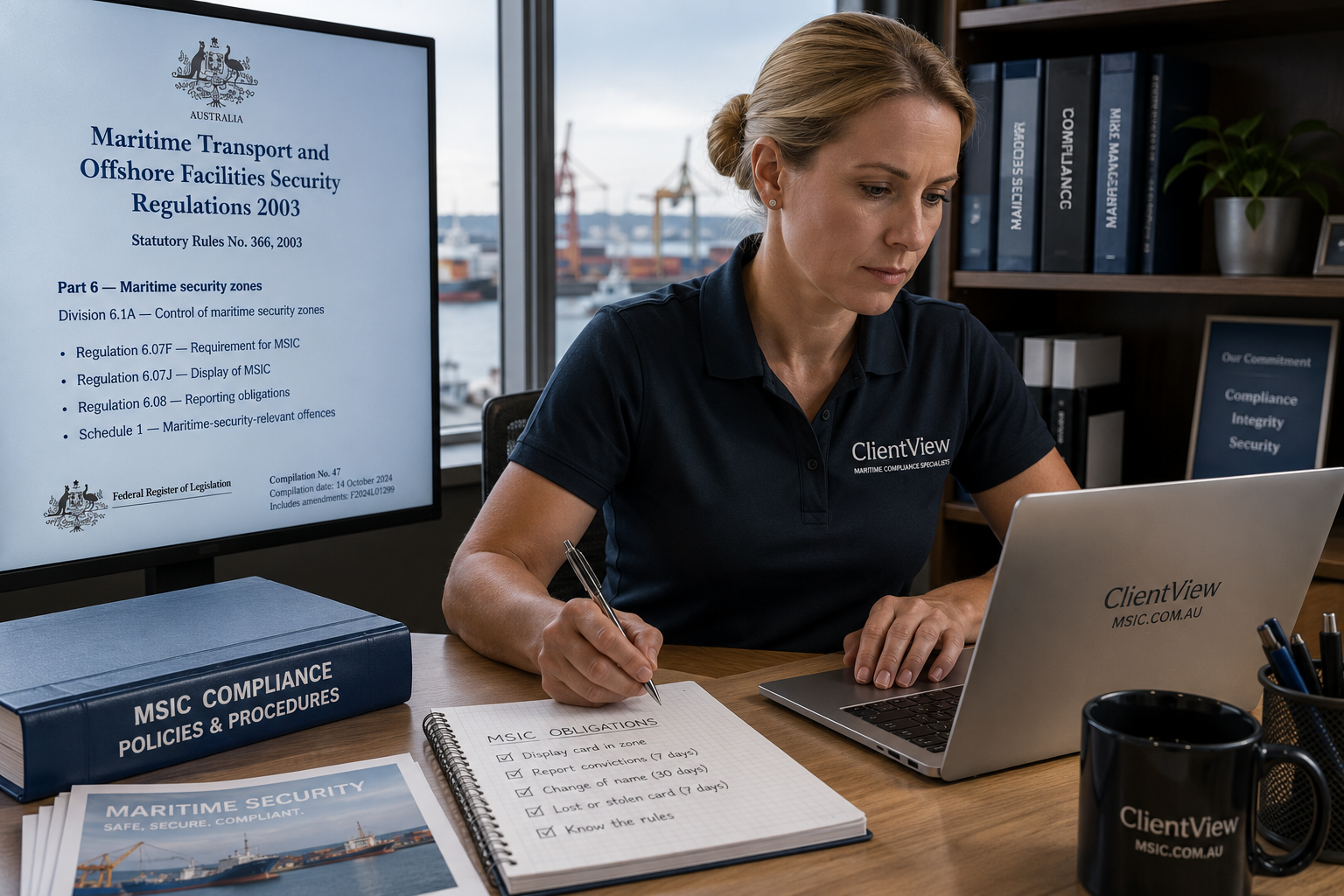
The MSIC scheme is governed by the Maritime Transport and Offshore Facilities Security Regulations 2003 (Cth), made under the Maritime Transport and Offshore Facilities Security Act 2003. Division 6.1A of the regulations sets the rules that matter to cardholders: you qualify for a blue MSIC only if your work requires unmonitored access to a maritime security zone at least once each year (regulation 6.07F), you must properly display your card whenever you are in a zone (regulation 6.07J), and you carry ongoing obligations to report certain convictions within 7 days of sentencing, a change of name within 30 days, and a lost or stolen card within 7 days. Breaking these rules is an offence, and your card can be suspended or cancelled.
Most MSIC holders never read the regulations behind their card, and fair enough: the compilation runs to more than 170 pages. But the rules in it decide who can hold a card, how it must be worn, and what can take it away. This guide translates the parts that matter into plain English, with the regulation numbers so you can check anything yourself.
Where the MSIC rules come from
The MSIC sits under two layers of law. The Maritime Transport and Offshore Facilities Security Act 2003 creates the framework of maritime security zones at Australian ports and offshore facilities. The Maritime Transport and Offshore Facilities Security Regulations 2003 fill in the detail, and Division 6.1A of those regulations is where almost everything about the MSIC lives: eligibility, issuing bodies, display rules, suspension and cancellation. The Department of Home Affairs administers the scheme, AusCheck conducts the background check on every applicant (regulation 6.08CA), and authorised issuing bodies such as ClientView process applications and issue the cards (Subdivision 6.1A.3). This article reflects the regulations as compiled on 22 January 2026 (Compilation No. 48, F2026C00073). The January 2026 amendments substitute “serious and organised crime” for “serious crime” and update Australian Crime Commission Act cross-references; they do not change the eligibility, card type or lifecycle rules this article explains.
Who can hold an MSIC: the operational need test
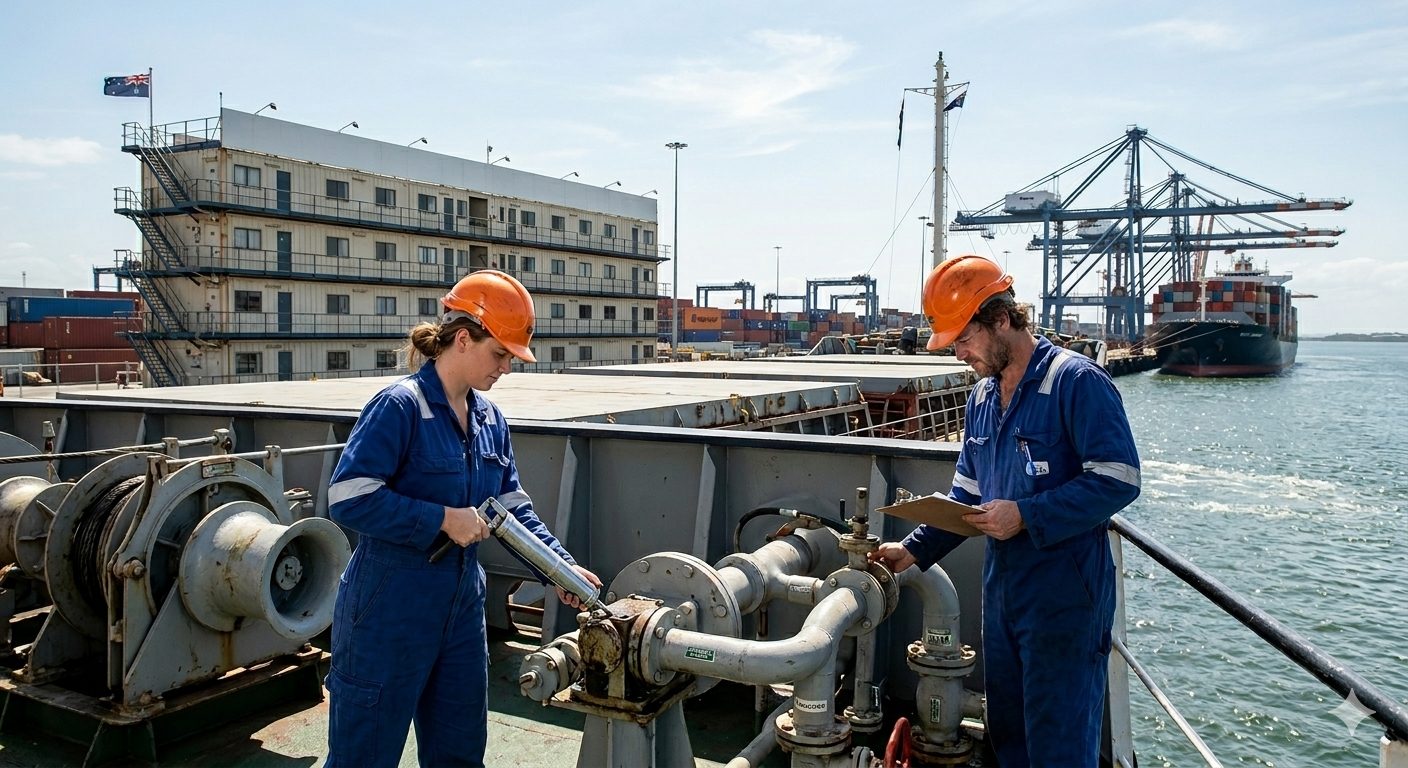
You are eligible for a blue MSIC only if you have an operational need: your occupation or business interests require, or will require, unmonitored access to a maritime security zone at least once each year (regulation 6.07F). Job titles do not decide this, the access test does. A white MSIC exists for a narrow group who work in the scheme itself, such as issuing body staff and certain Commonwealth and foreign officials. We cover the test in detail in our guide to operational need.
How you must wear and display your card
Inside a maritime security zone you must properly display a valid blue MSIC or temporary MSIC. Properly displaying means the whole front of the card is clearly visible, worn either at or above the waist on the front or side of your clothing, or on a band around your upper arm (regulation 6.07E). Failing to display your card in a zone is a strict liability offence: 5 penalty units for a first offence, 10 for a second within 2 years, and 20 for a third or subsequent offence (regulation 6.07J). A penalty unit is a dollar amount set by Commonwealth law and indexed over time, so the fines rise with it. Visitors who are escorted by a cardholder do not need their own card. A law enforcement officer or maritime security inspector can direct you to show a valid card where you are in a part of a maritime security zone and are apparently not properly displaying one, and must show you their own identification before giving that direction (regulation 6.08S(2) and (3)); failing to comply with the direction carries a penalty of 10 penalty units (regulation 6.08S(4)).
Your ongoing obligations as a cardholder
Getting the card is not the end of your compliance. The regulations impose reporting duties for the life of the card:
- Certain convictions: if you are convicted of and sentenced for a tier 1 or tier 2 maritime-security-relevant offence, or sentenced to imprisonment for a tier 3 offence, you must notify your issuing body or the Secretary in writing within 7 days of sentencing. Failing to do so carries 20 penalty units (regulation 6.08LB).
- Change of name: you must notify your issuing body in person within 30 days, with an original government-issued document showing the new name (regulation 6.08LCA).
- Change of address: holders of 4-year cards must give their issuing body written notice of address changes no later than 2 years and 30 days before the card's expiry date (regulation 6.08LD).
- Lost, stolen or destroyed cards: you must report the loss to your issuing body by statutory declaration within 7 days of becoming aware of it, and if the card was stolen, provide a copy of a police report (regulation 6.08R).
Suspension, cancellation and getting a card back
The Secretary can direct an issuing body to suspend a card, for example where a holder has been convicted of a maritime-security-relevant offence but not yet sentenced and is considered a security risk (regulations 6.08LE and 6.08LF). A suspended blue MSIC must be returned to the issuing body within 7 days of being told of the suspension. Cancellation grounds are listed in regulation 6.08M and include an adverse security assessment, an adverse criminal record, losing your right to work in Australia, and going 12 continuous months without an operational need. If your card is cancelled for an adverse criminal record or a qualified security assessment, you or your issuing body can apply to the Secretary within 28 days to have the cancellation set aside (regulation 6.08MA), and many decisions are reviewable by the Administrative Review Tribunal.
The three tiers of maritime-security-relevant offences
Schedule 1 of the regulations sorts disqualifying offences into three tiers. Tier 1 covers the most serious conduct, including terrorism, espionage, hijacking and piracy. Tier 2 includes offences such as assaulting or threatening a person on a vessel or in a port, and theft of a commercial vessel. Tier 3 covers serious general offences including murder, assault, weapons and drug trafficking offences. Where your record sits against these tiers determines whether AusCheck treats it as an adverse criminal record. Our guide to disqualifying offences works through the detail.
How long your card lasts
A blue MSIC is issued for either 2 or 4 years, measured from the last day of the month in which your background check was completed (regulation 6.08I). Cards linked to a visa expire no later than the visa does. When the card expires, so does your zone access, so plan ahead using our MSIC renewal guide.
How ClientView keeps you on the right side of the rules
As an Australian Government authorised issuing body, ClientView's job is to make compliance the easy path. We check your operational need evidence before your application is lodged, submit your background check to AusCheck, handle name changes and replacement cards, and remind you well before your card expires. If a regulation in this guide affects your situation, call us and a person who knows the scheme will talk it through with you.
Frequently asked questions
Do I need to wear my MSIC if I am only in a zone briefly?
Yes. The display requirement applies whenever you are in a maritime security zone, however short the visit, unless you are an escorted visitor or another exemption applies.
What happens if I forget my card at home?
You cannot enter a zone unmonitored without properly displaying a valid card. Your options are to retrieve the card or be escorted as a visitor by someone who holds one.
Do I have to report every criminal charge to my issuing body?
No. The 7-day reporting obligation applies when you are convicted of and sentenced for a tier 1 or tier 2 offence, or sentenced to imprisonment for a tier 3 offence.
Can I keep my MSIC while between jobs?
Yes, for a period. Your card can be cancelled if you go 12 continuous months without an operational need, so a short gap between roles is not a problem.
Ready to apply?
Apply for your MSIC or read our full guide to getting your MSIC fast.
Source: Maritime Transport and Offshore Facilities Security Regulations 2003 (Cth), Compilation No. 48 (22 January 2026), Division 6.1A including regulations 6.07E, 6.07F, 6.07J, 6.08I, 6.08LB, 6.08LCA, 6.08LD, 6.08LE, 6.08LF, 6.08M, 6.08MA, 6.08R, 6.08S and Schedule 1. This article is general information, not legal advice. Check current official sources at auscheck.gov.au. Last reviewed: 20 August 2026. Reviewer: Leigh Jackson.