Short Answer
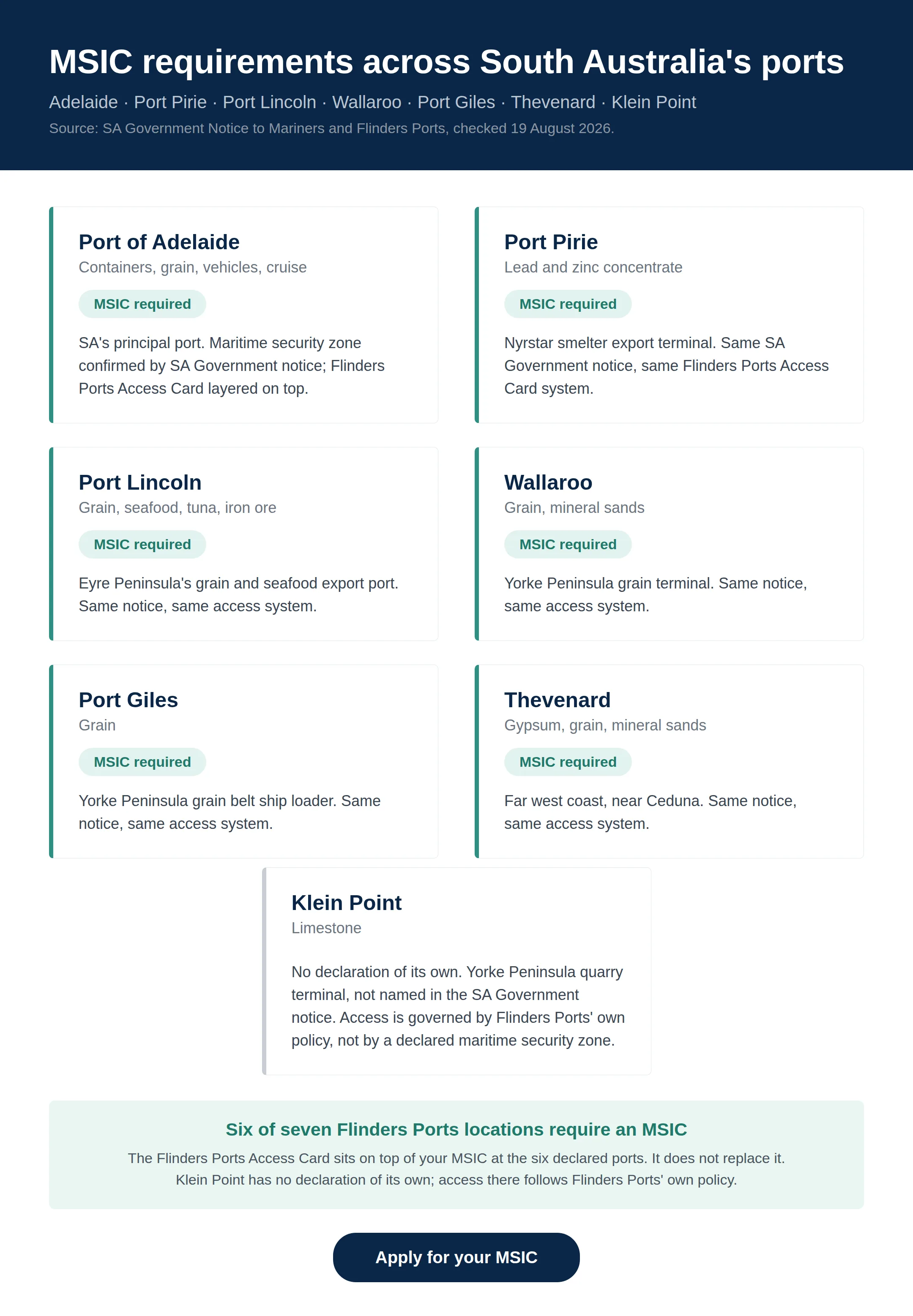
- Six of South Australia's trading ports, Adelaide, Port Pirie, Port Lincoln, Wallaroo, Port Giles and Thevenard, require an MSIC for unmonitored access to a maritime security zone at least once each year (r. 6.07F(1)). Klein Point has no declaration of its own, and access there is governed by Flinders Ports' own policy.
- One national MSIC covers every one of them. There is no separate South Australian card for the MSIC requirement itself.
- Most of these ports also use a Flinders Ports Access Card at the gate. It sits on top of your MSIC, not instead of it, and it is only issued to people who already hold an MSIC or have an application in progress.
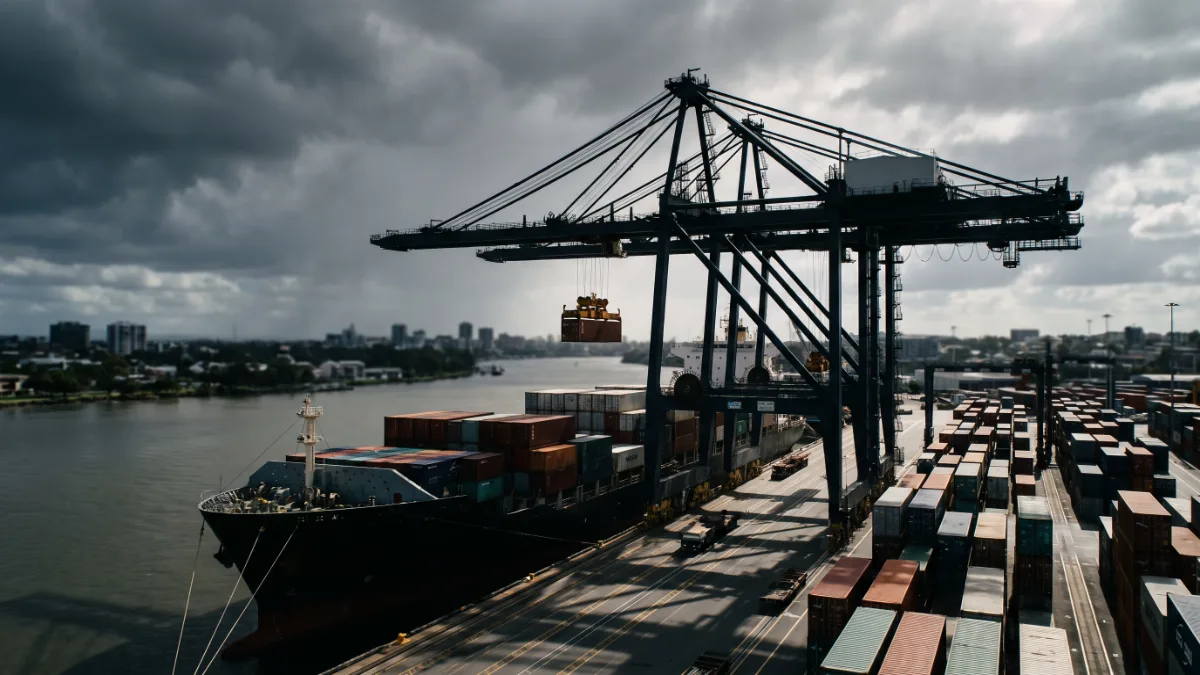
South Australia's export trade runs through a wider spread of ports than most states: a major container and cruise terminal at Adelaide, mineral and grain terminals scattered along the Yorke and Eyre Peninsulas, and a smelter port at Port Pirie. An MSIC is needed at all seven: at six of them because a maritime security zone has been declared, and at Klein Point through Flinders Ports' own policy. What changes is what sits alongside it.
One card, seven South Australian ports
The SA Government's Notice to Mariners names Adelaide, Port Pirie, Port Lincoln, Wallaroo, Port Giles and Thevenard directly, confirming a maritime security zone at each, and Flinders Ports' security page states that your valid MSIC must be displayed in accordance with MSIC display requirements at all times. Klein Point isn't in that notice and has no declaration of its own: it is a Flinders Ports single-purpose limestone port on Yorke Peninsula where access is governed by Flinders Ports' own policy. Layered on top of the MSIC at most of these ports is a second, port-specific credential: the Flinders Ports Access Card, covered in detail below.
Port of Adelaide
South Australia's principal port, handling containers, grain, vehicles and cruise traffic through its outer harbour. The maritime security zone here is confirmed directly by the SA Government notice, and the Flinders Ports Access Card sits on top of the MSIC for routine gate access.
Port Pirie
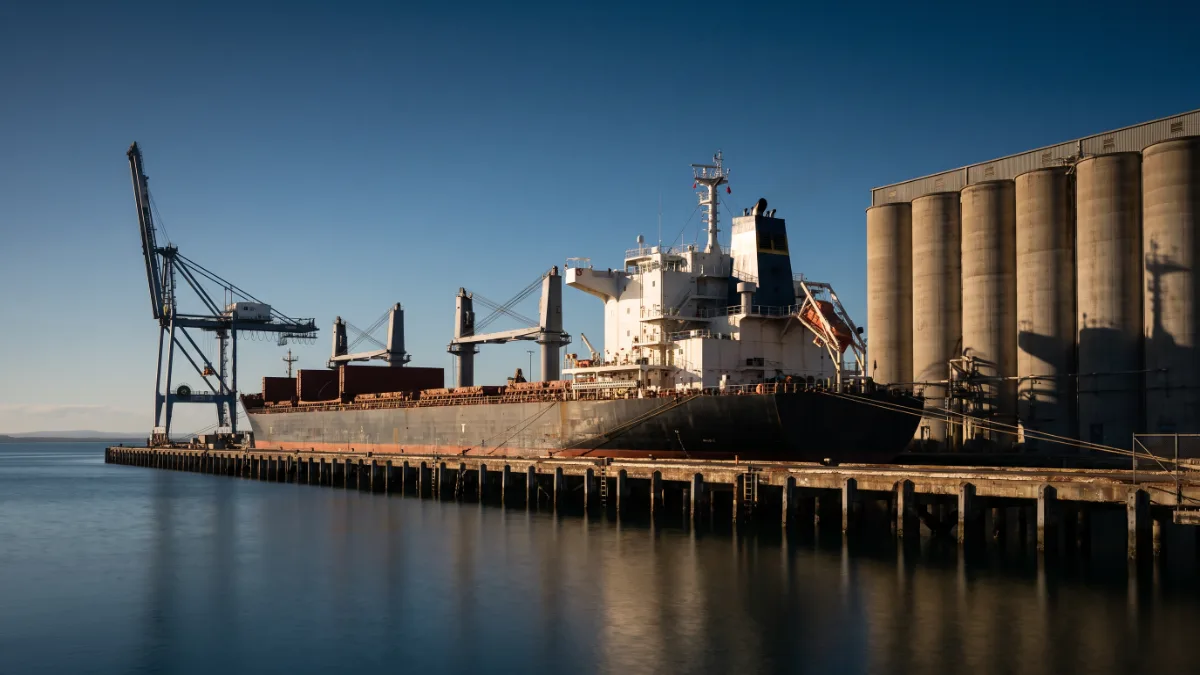
Home to the Nyrstar smelter's lead and zinc concentrate exports. Same state notice, same maritime security zone rule, same Flinders Ports Access Card system as Adelaide.
Port Lincoln, Wallaroo, Port Giles and Thevenard
These four smaller ports handle grain, seafood, mineral sands and gypsum out of the Eyre and Yorke Peninsulas and the far west coast near Ceduna. All four are named in the same SA Government notice, and all four run on the same access rules: an MSIC for the zone, a Flinders Ports Access Card for routine gate access.
Klein Point
A Flinders Ports single-purpose limestone port on Yorke Peninsula. Klein Point has no declaration of its own, and access is governed by Flinders Ports' own policy: the operator states that access to this port is restricted and that its Klein Point Rules apply to all shipping in port waters (Flinders Ports, Klein Point).
The Flinders Ports Access Card, explained
Flinders Ports operates all seven of these ports, and layers its own Access Card on top of the MSIC at most of them. It's a common point of confusion, so it's worth being precise about what the card does and doesn't do.
The Access Card is not an alternative to the MSIC. It's only issued to people who already hold an MSIC or have an application in progress, and it's used for routine gate access at ordinary Security Level 1. If the security level rises, direct MSIC display to security personnel is required regardless of whether an Access Card is held. Applying for your MSIC is the first step either way.
Applying once, for wherever the work takes you
If your work takes you to more than one of these seven ports, one MSIC application covers all of them. Any port-specific card, like the Flinders Ports Access Card, is arranged separately once the MSIC is in hand. Between 20 and 45 minutes online if you have your details to hand. Apply for your MSIC, verify your identity at a participating Australia Post outlet, and ClientView lodges every ready application with AusCheck each business day.